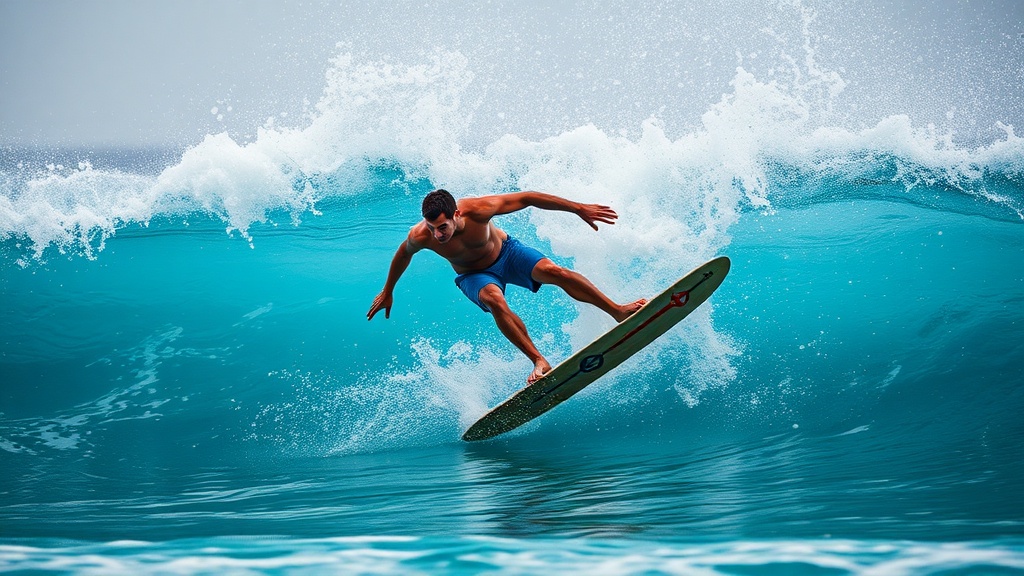
Building Explosive Leg Strength for Skimboard Maneuvers

Imagine you're mid-session, tracking a perfect wave, and you need that sudden, sharp burst of power to whip your board through a turn. You plant your feet, push off, and—nothing. Your legs feel heavy, the snap isn't there, and the momentum dies before you even reach the shore. This isn't a lack of skill; it's a lack of specific explosive power. This guide covers how to develop the fast-twitch muscle fibers and unilateral strength required to make those high-speed maneuvers feel effortless rather than a constant struggle against physics.
Skimboarding demands more than just endurance. While long sessions require stamina, the actual performance—the cuts, the turns, and the jumps—depends on explosive lateral movements and rapid weight shifts. If your lower body can't react to the water's surface instantly, you'll always be a step behind the wave. We'll look at the specific training methods that build that reactionary strength.
What exercises build explosive power for skimboarding?
To get that snap back in your turns, you need to move beyond standard weightlifting. You need movements that involve rapid force production. Plyometrics are your best friend here. These aren't just random jumps; they are intentional, high-intensity movements designed to teach your nervous system to fire more efficiently.
- Lateral Bounds (Skater Jumps): This is the bread and butter for skimboarders. Since most of your movement is side-to-side, you need to practice explosive lateral stability. Focus on landing softly and holding the position for a split second to build control.
- Box Jumps: These build pure vertical and horizontal power. A high box jump forces your muscles to contract with maximum intensity.
- Bulgarian Split Squats: This is a unilateral movement. Since you're rarely balanced perfectly on two feet during a hard cut, training one leg at a time is vital. It builds the stabilizing muscles around the knee and hip.
Don't just jump for the sake of jumping. Quality beats quantity every time. If your form starts to break down or your landings become heavy and loud, stop. You're training for speed and precision, not just fatigue. A controlled, explosive movement is far more effective for your sport than a sloppy, high-rep set of basic squats.
How much weight should I lift for better agility?
There's a common misconception that lifting heavy will make you slow or "bulky." In reality, strength is the foundation of speed. You can't be fast if you're weak. However, the way you lift matters immensely. For skimboarding, we want to focus on strength-speed. This means lifting weights that allow for a rapid concentric (the lifting phase) movement.
A good approach is to incorporate heavy, compound movements into your routine to build a foundation, then transition into explosive movements. Think about the heavy lifting as building the engine, and the plyometrics as tuning the car for racing. According to the National Strength and Conditioning Association, developing both maximal strength and explosive power is the most effective way to improve athletic performance across various disciplines.
When you're in the gym, try a split routine. Dedicate one day to heavy, slow strength (like deadlifts or heavy lunges) and another day to high-velocity movements (like kettlebell swings or medicine ball slams). This ensures you're hitting both the force production and the speed components of your athleticism. It's about being a well-rounded athlete, not just a person who can lift a heavy bar.
Can I improve my reaction time through training?
Reaction time in skimboarding is essentially how fast your brain can process the board's position and tell your legs to adjust. While you can't change your baseline neurological speed, you can certainly optimize your body's ability to execute those commands. This is where proprioception—the sense of where your body is in space—comes into play.
To improve this, you need to train on unstable surfaces or use tools that demand quick adjustments. Balance boards or even training on uneven terrain (like sand or grass) can help. If your body knows how to stabilize itself when a footing is inconsistent, it will react much faster when the water's surface changes under your board.
Try incorporating single-leg balance drills into your warm-up or even your daily life. Standing on one leg while brushing your teeth might seem trivial, but it strengthens the tiny stabilizer muscles in your ankles and knees. These are the very muscles that keep you upright when a wave hits your board unexpectedly. For more insight into the mechanics of human movement, checking out resources like Biomechanics studies can provide a deeper understanding of how force and motion interact.
A solid training program for skimboarding should look something like this:
| Focus Area | Recommended Movement | Frequency |
|---|---|---|
| Explosive Power | Skater Jumps, Box Jumps | 2x per week |
| Unilateral Strength | Bulgarian Split Squats, Step-ups | 2x per week |
| Stability/Proprioception | Single-leg Balance, Bosu Ball work | Daily/Warm-up |
| Max Strength | Deadlifts, Goblet Squats | 1x per week |
Remember, the goal isn't to become a bodybuilder. You're an athlete. Every rep should serve the purpose of making you a more agile, powerful, and responsive skimboarder. If a movement doesn't translate to better board control or more explosive turns, it probably doesn't belong in your program. Keep the training specific, keep it intense, and keep it focused on the lateral, explosive nature of the sport.